
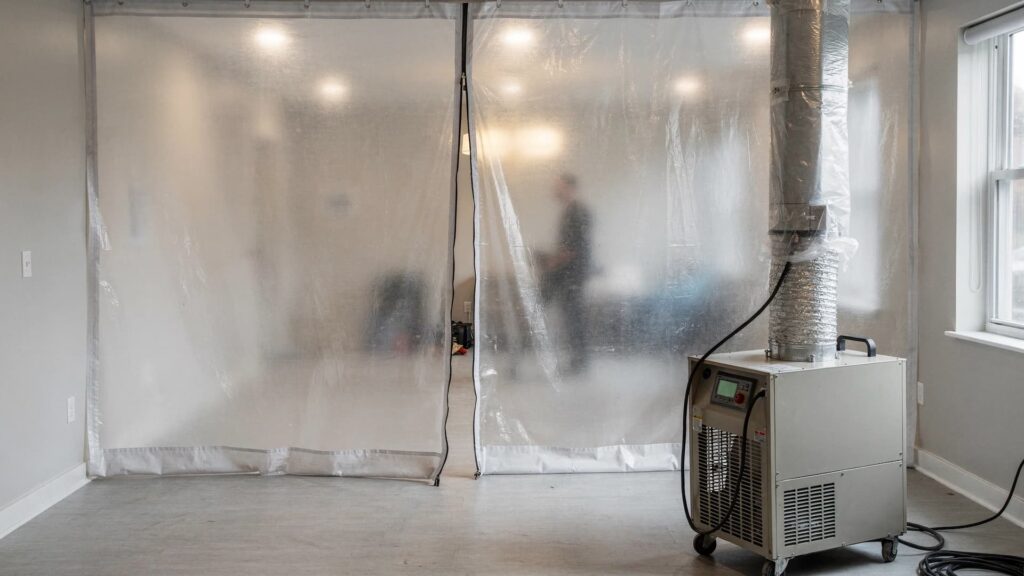
Ice dam leaks are one of the most frustrating winter problems in Boston-area homes because they often start when everything looks “fine” from the street. One day you notice a faint stain on the ceiling near an exterior wall, a little paint bubbling above a window, or a slow drip that appears during a warm-up—then disappears again when temperatures drop. It’s easy to assume the roof is “broken,” but ice dam leaks are a different mechanism: the roof may be intact, yet water is still finding a way inside.
This guide focuses on three things homeowners actually need:
- How to spot an ice dam leak early (before the damage gets expensive),
- How to reduce interior damage safely using temporary, low-risk steps, and
- How to prevent repeat leaks by addressing the underlying causes (heat loss, ventilation, insulation gaps, and winter humidity).
You’ll notice we stay practical: no risky roof climbing and no “hero moves.” The safest approach is always to protect the home from the inside first, then address the roof-edge ice properly and prevent the same conditions from repeating.
Quick confirmation: is this likely an ice dam leak?
Ice dam leaks have a few “tells” that show up again and again in Boston winters—especially during freeze/thaw swings and after heavy snowfall.
1) The leak appears during a warm-up, not necessarily during the storm
With ice dams, water often starts moving when outside temperatures rise into the 30s–40s°F and the roof begins to melt snow. That meltwater can refreeze at the colder roof edge (the eaves) and form a ridge of ice. Once that ridge blocks drainage, water backs up under shingles and enters the roof assembly. This is why you may see dripping after the storm, not during it.
2) The first interior signs are often near exterior walls and window headers
Many ice dam leaks show up as stains on ceilings near exterior walls, dampness above windows, or small wet spots where the roof meets the wall line. That’s not a rule—but it’s common, because ice dams form at the roof edge and water can travel along framing members before it becomes visible.
3) You see lots of icicles, but the bigger clue is the “ice ridge” at the eaves
Icicles alone don’t prove an ice dam, but a thick band of ice along the roof edge (sometimes hidden behind gutters) is more telling. In many cases, the gutter line becomes a cold trap: water melts higher on the roof, reaches the colder edge, freezes, and builds a dam.
4) The problem repeats in the same roof section every winter
If the same bedroom corner, same upstairs hallway, or same living-room ceiling spot shows up each winter, that pattern strongly suggests a repeatable condition: heat loss/air leakage above that area plus poor drainage at the eaves.
5) Your attic has subtle winter moisture signs
If you can check safely: frosted nails, damp insulation, or darkened roof sheathing near the eaves can indicate warm moist air escaping from the house and condensing in the attic—conditions that also support uneven roof melt (which feeds ice dam formation).
What an ice dam leak really is (plain-English explanation)
An ice dam is essentially a winter traffic jam for meltwater. Here’s the chain reaction:
- Warmth escapes into the attic or roof deck (often through gaps around recessed lights, attic hatches, plumbing chases, or unsealed top plates).
- That warmth creates a warm roof area higher up where snow melts.
- Meltwater runs down toward the edge of the roof—where it reaches a colder zone at the eaves.
- At the eaves, water refreezes and gradually builds an ice ridge.
- As the ridge grows, it blocks new meltwater from draining. Water backs up and can slip under shingles and into the roof assembly.
This is why ice dam leaks aren’t always a “bad roof.” They’re often a building science problem: heat movement + air leakage + winter moisture + roof-edge refreezing. Fixing the root causes is what stops repeat damage.
Early warning signs outside (safe to check from the ground)
Uneven snow melt patterns across the roof
If one roof section looks “bare” while another stays snow-covered, the bare section is often warmer. That warmth can be caused by inadequate insulation, air leakage from living spaces below, or ductwork running through the attic. Uneven melt is not automatically an ice dam—but it’s a strong contributor.
A thick ice line along the roof edge, especially above living areas
Ice dams are most common over heated areas (bedrooms, kitchens, living rooms) rather than over unheated garages—because heat loss is a big driver. If the eaves above a heated room show heavy ice buildup repeatedly, that’s a red flag.
Gutters and downspouts that appear frozen or blocked
When gutters are clogged with frozen slush and ice, drainage gets worse. Even without a “classic” ice ridge, blocked gutters can help water pool at the edge and refreeze. This doesn’t mean “go chip the gutter”—it means treat it as evidence that drainage is compromised.
Heavy icicles + interior symptoms
Icicles can form even in normal conditions. But if you have both large icicles and interior staining/dripping, the combination strongly points toward a roof-edge freeze issue rather than a simple one-time spill or condensation.
Early warning signs inside (what you’ll notice first)
Faint yellow/brown staining on ceilings or upper walls
Ice dam leaks often start as a stain rather than a dramatic drip. Drywall paper absorbs moisture and shows discoloration even when the cavity is only intermittently wet. If the stain grows after warm days and stalls after cold nights, that “on/off” behavior fits the ice dam pattern.
Bubbling paint, peeling, or a soft drywall feel
Paint can bubble when moisture is trapped behind it. If you press gently and the area feels spongy, the drywall may already be compromised. A soft ceiling can become a safety risk if water is pooling above it, so treat this as urgent.
Moisture near window trim or at the top of a wall
Because water can travel along framing, it sometimes shows up at the top of a wall or above a window. That can confuse people into thinking “the window is leaking,” when the real entry point is up at the roof edge.
A musty smell that appears after thaw cycles
Even if you don’t see visible growth, recurring moisture can create a damp odor in a closet, a bedroom corner, or an attic hatch area. Odor isn’t a diagnosis by itself—but it can be an early clue that something is getting wet and staying wet.
Attic clues (only if you can check safely)
Boston homes—especially older ones—often have a mix of insulation styles, patchwork air sealing, and bathroom fans venting in questionable ways. A quick attic look can reveal clues that tie directly to ice dam formation.
Frosted nails or damp roof sheathing near the eaves
Frost on nails can mean warm, moist indoor air is escaping into the attic and condensing. When outside temps drop, that condensation freezes; when temps rise, it melts and can add moisture. This same warm air leakage also warms the roof deck and increases snow melt.
Insulation that’s thin or pulled back at the roof edge
At the eaves, insulation is frequently compressed or missing due to tight rafter bays, storage, or poor installation. When insulation is weak at the perimeter, the roof edge stays colder, which encourages refreezing—exactly where you don’t want it.
Blocked soffit vents or missing baffles
Soffit vents are intended to bring in cold, dry air at the eaves, while ridge or roof vents allow it to exit higher up. If insulation blocks soffit airflow because baffles weren’t installed, the attic can become warmer and wetter—two conditions that worsen ice dams.
Safety note: If your attic has questionable flooring, exposed wiring, or you’re not confident moving around, skip the attic check. You can still manage the problem by focusing on indoor damage control and professional evaluation.
First-hour damage control (the safest, highest-impact steps)
When water is inside, your priorities are safety, containment, and drying. The goal is not to “fix the roof” in the first hour; it’s to prevent ceilings from collapsing, protect electrical hazards, and keep moisture from spreading.
1) Treat electricity like a real hazard (because it is)
If water is dripping near light fixtures, ceiling fans, outlets, or extension cords, avoid touching those areas. In many cases, the safest move is to turn off the power to the affected circuit at the breaker panel. Water doesn’t drip in a straight line; it can follow wiring and framing, so “it’s not on the outlet” is not always reassuring. If you’re unsure, err on the side of shutting off power and using a flashlight.
2) Contain water in a way that protects floors and reduces spread
Buckets are obvious, but floor protection is where homeowners often lose money. Use plastic sheeting or contractor trash bags under towels to keep water from soaking into hardwood seams or subflooring. If you have a slow drip, a simple “drip catcher” can help: position a container and guide drips with a folded towel so the water doesn’t splash outward.
3) Reduce indoor humidity immediately
High humidity slows drying and increases the chance of musty odors and microbial growth. A dehumidifier is one of the best first tools because it removes moisture from the air—something fans alone cannot do. Place it near the affected room if possible, keep doors open for airflow unless you’re trying to isolate the space, and empty the reservoir frequently or use a pump/drain line.
4) Don’t “trap” moisture by overheating the room
Turning the heat way up can feel like the right move, but heat without moisture removal can increase evaporation into the air and raise humidity. Drying is most efficient when you balance gentle warmth, airflow, and dehumidification. If you only heat and don’t dehumidify, you may simply move moisture from the ceiling into the air and into other parts of the house.
5) Document early—because the first condition is the clearest
Take photos of the ceiling stains, any dripping, and (from the ground) the roof edge if visible. Write down the date/time, recent weather (heavy snow, thaw day), and where the water appeared. This helps both diagnosis and any insurance conversation later. The best documentation captures the “before” state and the progression.
Handling ceiling bulges and soft drywall (what to do, what not to do)
A bulging ceiling is one of the scariest moments in winter leaks. It may indicate water pooling above the drywall. The wrong response can create a mess—or a safety risk.
Why bulges happen
Drywall can hold water like a shallow bowl. Water accumulates above it, the drywall sags, and the weight increases. Even a few gallons can be heavy. If the leak continues, the ceiling can fail suddenly.
What you can do safely
If you see a bulge, move valuables away from the area and protect the floor. Avoid standing directly under the bulge for long periods. If water is actively pooling and the ceiling looks close to failing, it’s often safer to have a professional handle controlled drainage and removal. The goal is to avoid an uncontrolled collapse that spreads water and debris throughout the room.
What to avoid
Many people want to poke a hole in the ceiling to drain it. That can work in some situations, but it also creates risks: debris falls, water can surge, and you may disturb older ceiling materials you don’t want aerosolized. If you’re in an older home and you’re uncertain about materials or safety, it’s better to focus on containment and drying while you arrange help.
Temporary steps that may reduce the leak (without roof climbing)
The phrase “stop the leak temporarily” is tricky with ice dams because the source is often at the roof edge, and roof access in winter is dangerous. The safest homeowner approach is to reduce interior impact and, where possible, reduce meltwater feeding the dam without getting on the roof.
Step A: Reduce the meltwater supply (indirectly)
Ice dams are fed by melting snow higher on the roof. The more heat loss from the house into the attic/roof deck, the more melting occurs. You can’t re-insulate overnight, but you can reduce obvious heat sources:
- Keep attic access doors closed and sealed as best as possible.
- Avoid running high-heat attic fans (they can pull warm indoor air upward through leaks).
- Maintain reasonable indoor humidity (high humidity worsens attic frost and wetting).
This won’t “solve” the dam instantly, but it can reduce the intensity of meltwater during warm cycles.
Step B: Remove snow safely from the roof edge—only from the ground
A roof rake used from the ground can reduce the snow load near the eaves and lower the meltwater reaching the dam. This must be done carefully to avoid damaging shingles and to avoid injuries. It’s not about scraping down to bare shingles; it’s about reducing the amount of snow that can melt and refreeze at the edge.
If using a roof rake isn’t feasible or safe at your property, skip it. Ground safety always wins.
Step C: Improve drainage paths you can access safely
Sometimes downspouts or splash blocks are frozen in ways that worsen pooling near the house. While you should not chip ice aggressively, you can make sure downspout outlets and drainage areas are not buried and that meltwater has somewhere to go away from the foundation. Better drainage won’t eliminate an ice dam, but it can prevent compounding issues like basement seepage or refreezing at walkways.
Why “quick fixes” can make ice dams worse
Chipping ice off shingles
This is one of the most common mistakes. Chipping can crack shingles, damage flashing, and create new entry points for water. It also puts you at risk of falls, especially on icy ladders.
Pouring hot water on the roof
Hot water can refreeze downstream, add more ice mass, and create slippery conditions. It can also shock materials in ways that reduce roof lifespan.
Using de-icing products incorrectly
Some products can damage roofing materials or accelerate corrosion in gutters. Even when a product is designed for roofs, the method and placement matter. In most homes, it’s better to treat de-icing as a professional decision rather than a DIY experiment on your shingles.
Drying and preventing secondary damage (the part that saves money)
Stopping the leak source is important, but drying is what prevents long-term problems like warped materials, persistent odors, or microbial growth. Drying is not “set a fan and hope.” It’s about controlling moisture pathways.
Use a dehumidifier as the anchor tool
A dehumidifier removes moisture from the air so wet building materials can release moisture more effectively. Place it where the air can circulate, keep filters clean, and empty it regularly. If you have a pump drain option, that’s even better because it allows continuous operation.
Airflow should be strategic, not chaotic
Fans should support evaporation from wet surfaces, but you don’t want to blow air hard across visibly contaminated areas or into ceiling cavities. Gentle airflow in the room, combined with dehumidification, is generally safer for homeowners than aggressive blasting that can spread dust and particles.
Wet insulation is often the hidden problem
Ceiling stains frequently mean insulation above is damp. Wet insulation loses performance and can keep the area cold/wet longer. If insulation remains wet, the ceiling can re-wet even after the drip stops. Identifying and addressing wet insulation is one reason professional drying and moisture mapping after an ice dam leak is often recommended after significant winter leaks.
Moisture doesn’t respect room boundaries
Even if the leak is in one room, humidity can spread through hallways and closets. Keep an eye on adjacent spaces, especially closets on exterior walls, because they often have poor airflow and can stay damp longer.
When to bring in a professional (and why it’s not “overreacting”)
Ice dam leaks are a combination of roof-edge conditions and indoor moisture impact. The moment you have ongoing dripping, ceiling bulging, or repeated winter staining, professional assessment is often the fastest way to prevent compounding damage.
If the priority is stopping the source safely
Professionals can handle professional ice dam removal at the roof edge in a way that limits roof damage and reduces safety risk. The key is doing it safely and without creating new roof problems.
If the priority is drying and verifying moisture is truly gone
Once water has entered ceilings/walls, it can remain in cavities even when surfaces look dry. Professional drying typically includes moisture checks, controlled airflow, and dehumidification sized for the space. This reduces the chance of hidden dampness that returns as odor, staining, or material deterioration.
(Notice we keep this informational and process-based—so it doesn’t overlap with your service page positioning.)
Preventing ice dam leaks long-term (what actually works in Boston winters)
Prevention is not a single product. It’s a system: air sealing + insulation + ventilation + humidity control + drainage maintenance. When those pieces work together, roofs stay colder and more uniform, meltwater is reduced, and refreezing at the eaves is less severe.
1) Air sealing: the hidden driver of ice dams
In many Boston-area homes, the biggest problem isn’t the amount of insulation—it’s air leakage. Warm air escaping into the attic warms the roof deck from below. Common leakage points include:
- attic hatches and pull-down stairs,
- recessed lights and ceiling fixtures,
- plumbing and chimney chases,
- top plates of interior walls,
- bathroom fan housings.
Air sealing these areas reduces warm air flow into the attic and helps the roof stay colder and more consistent. It also reduces attic condensation and frost—two conditions that can add moisture to the roof assembly.
2) Insulation: coverage matters as much as R-value
Insulation works best when it’s continuous and properly installed. Gaps, compression, and wind washing (cold air moving through insulation near soffits) reduce performance. Eaves are a common weak spot: insulation is often thin or blocked, and ventilation baffles may be missing. Improving insulation coverage near the roof edge helps reduce temperature differences that encourage refreezing.
3) Ventilation: soffit-to-ridge airflow keeps attics stable
A well-vented attic helps maintain a cold roof deck and removes moisture. But ventilation only works when airflow paths are clear. If soffit vents are blocked by insulation, the system can’t bring in cold air effectively. Proper baffles maintain an air channel from soffit to the attic. This is a classic Boston issue in older homes where insulation was added without correcting airflow.
4) Indoor humidity control: a winter factor many people ignore
High indoor humidity increases the amount of moisture that can escape into the attic through air leaks. That moisture can condense, freeze, and later melt—adding to wetting. Keeping winter indoor humidity in a reasonable range helps reduce attic frost. Exhaust fans should vent outdoors (not into an attic), and basement humidity should be managed too, because moisture can migrate upward through the house.
5) Gutters, downspouts, and drainage: keep meltwater moving away
Even with a perfect attic, drainage matters. Clogged gutters can trap water at the roof edge. Downspouts that discharge too close to the foundation can create refreezing hazards and basement moisture issues. Regular maintenance and correct water routing reduces winter complications that “stack” on top of ice dam conditions.
6) Monitoring and small improvements before the next storm
If your home has a history of ice dam leaks, small proactive steps help:
- check attic access seals,
- verify bathroom fan ducts terminate outdoors,
- keep gutters clean before deep winter,
- watch roof-edge patterns after storms and thaw cycles,
- track which roof sections repeat the problem.
Prevention is often incremental: reducing the severity each winter until the conditions that drive ice dams are corrected.
After the storm: what to monitor for the next 72 hours
Even if dripping stops, the story may not be over. Ice dam leaks can be intermittent. Water may enter during a thaw and then freeze again at night, pausing visible signs while moisture remains in cavities.
Watch for stain expansion and paint changes
If the stain grows, darkens, or becomes softer to the touch, moisture is still active. A “dry-looking” stain can still hide damp insulation above it.
Pay attention to odor and humidity spikes
If a room smells damp after the event or humidity rises noticeably, it may indicate ongoing drying needs. Closets and corners are common odor zones because airflow is low.
Don’t assume “it’s fine” until the materials are truly dry
Many homeowners stop once the drip stops. But the best outcomes come when drying is verified and the source conditions are addressed—so the next warm-up doesn’t restart the cycle.

