
Firefighting Water Damage Cleanup & Structural Drying After Fire in Boston, MA
Once the fire is extinguished, the water loss often keeps developing. We handle suppression-water extraction, sprinkler discharge cleanup, moisture mapping, and structural drying so wet drywall, insulation, framing, subfloors, and hidden cavities can be stabilized before secondary damage spreads further.
- Identify where firefighting water or sprinkler discharge traveled, including lower walls, floor edges, and adjoining spaces
- Extract standing water and trapped moisture where wet materials can be relieved immediately
- Map moisture in drywall, insulation, framing, subfloors, and cavities so drying starts from actual readings
- Set up controlled drying, dehumidification, and documentation to move the property toward the next restoration stage


“After the fire department finished, there was still water all through the first floor and inside the lower walls. They extracted what they could right away, checked hidden moisture, and got a real drying plan in place instead of just leaving fans everywhere.”
“Our sprinkler system discharged into two condo units. They tracked where the moisture actually moved, dried the framing and flooring edges, and kept us updated with readings the whole way through.”
“What helped most was that they treated it like a post-fire drying job, not a normal leak. They explained what was still wet behind the surfaces and documented when the space was ready for the next phase.”
After a fire, the water loss often starts where the flames stop.
Firefighting hoses, sprinkler discharge, and suppression systems can leave a property carrying a second active loss even after the emergency is over. Water pushes into lower wall sections, under flooring, into insulation, and through connected rooms while heat-stressed finishes open pathways that would not exist in a routine leak.
This stage is not about full reconstruction or smoke cleanup. It is about removing as much suppression water as possible, controlling humidity, and drying wet structural materials so the building can move from “the fire is out” to “the moisture is being stabilized correctly.”
Post-fire water keeps damaging materials long after the visible runoff slows down.
Suppression water does not affect every assembly the same way. Some materials release moisture quickly. Others hold it deep inside and continue to deteriorate if drying is delayed.
Soaked assemblies stay wet below the surface
Drywall, insulation, trim, and lower wall sections may look better once standing water is gone, but the core of the assembly can still be saturated and unstable.
Hidden moisture keeps moving
Water can wick upward, travel laterally along framing, and settle into floor cavities, underlayment, and subfloor transitions where it is not visible from the room.
Different materials dry at different speeds
Surface drying does not mean the structural layers are ready. Insulation, wood framing, layered floors, and enclosed spaces often lag well behind the room’s apparent condition.
Fast control protects the next restoration phase
The sooner moisture is brought under control, the easier it is to plan cleaning, evaluate salvageability, and move the property toward repair instead of losing more materials to delayed deterioration.
What firefighting water cleanup and structural drying typically includes.
This service is focused on the moisture-control phase after a fire, not the entire restoration project. The goal is to remove suppression water, dry wet assemblies, and keep the property moving toward a more stable condition.
Emergency extraction after firefighting
Remove standing water, heavy floor accumulation, and reachable trapped water from suppression activity or sprinkler discharge as quickly as access conditions allow.
Structural drying setup
Position drying equipment based on where moisture actually moved so wet framing, lower wall sections, flooring edges, and affected rooms are addressed as a system.
Dehumidification after suppression
Pull excess moisture out of the air and out of wet materials to support a controlled drying environment instead of allowing the property to remain damp and unstable.
Moisture mapping and wet-area definition
Check where water reached beyond what is obvious at the surface so drying decisions are based on readings, material behavior, and the actual moisture footprint.
Cavity and hidden-moisture checks
Evaluate enclosed spaces, insulation pockets, wall cavities, and subfloor zones where moisture often remains after the visible water is gone.
Monitoring, drying progression, and records
Re-check moisture levels, adjust the drying plan as conditions change, and document progress so the property is easier to hand off to cleaning, repair, or further restoration work.
Drying after a fire is not the same as drying after a routine leak.
Post-fire water often reaches materials through multiple directions at once. Hoses, sprinkler heads, runoff, and heat-opened assemblies can leave a more complicated moisture pattern than a single plumbing source. The result is usually a wider footprint, more hidden wet zones, and a stronger need for measured drying decisions.
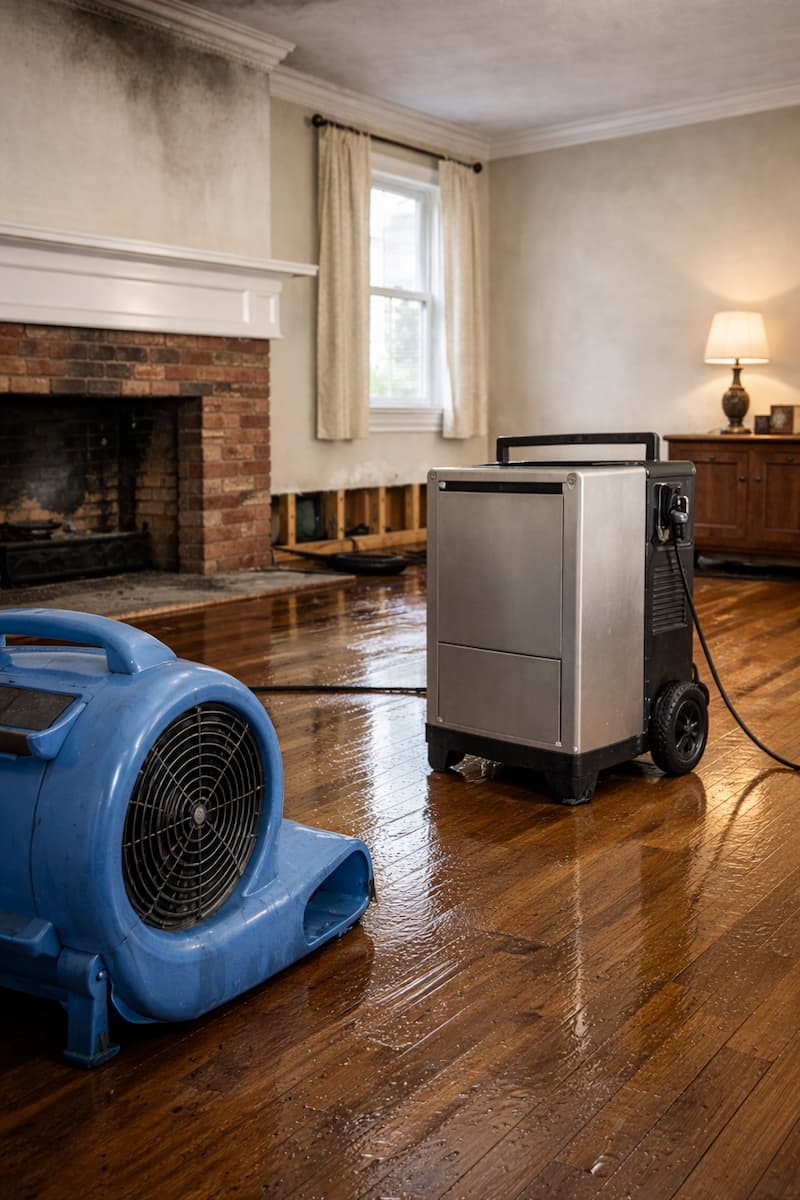
The room can look drier while the structure is still holding water.
After firefighting or sprinkler discharge, moisture often remains in the places that do not dry evenly on their own. Surface cleanup helps visibility, but it does not confirm that assemblies below the finish layer have stabilized.
That is why this phase focuses on where water lingers: inside wall cavities, in soaked insulation, along framing members, under floor coverings, and in subfloor or transition zones that keep holding moisture after visible runoff has already been removed.
Walls and lower sections
- Wet drywall at the base of walls
- Insulation holding water out of sight
- Moisture staying inside cavities after surfaces look improved
Framing and structural members
- Studs, plates, blocking, and trim backers absorbing moisture at different rates
- Heat-stressed assemblies allowing deeper wetting than expected
- Wood members requiring monitoring instead of visual assumptions
Floors, edges, and subfloors
- Water trapped at flooring edges, thresholds, and underlayment
- Subfloor moisture remaining after the top surface feels dry
- Layered floor systems drying more slowly than open surfaces
Enclosed paths and connected spaces
- Chases, closets, soffits, and tightly enclosed areas
- Moisture migration into adjacent rooms or units
- Wet pockets that continue affecting the property after visible water is gone
A measured path from wet suppression loss to stabilized drying conditions.
This work moves best when the drying plan follows the moisture pattern instead of treating every room the same.
Inspect and map wet areas
Review the affected footprint, identify where firefighting water or sprinkler discharge traveled, and confirm which assemblies are still actively wet.
Extract water where immediate removal helps
Remove standing water and concentrated wet accumulations so the heaviest loading on floors and materials is reduced before full drying begins.
Set drying equipment and dehumidification
Place airflow and moisture-control equipment based on the structure, material types, and hidden wet zones rather than using a generic setup.
Monitor moisture and adjust the plan
Re-check readings, watch how different materials are responding, and reposition or refine the drying strategy as the property moves through the stabilization phase.
Document progress and next-step readiness
Keep a record of moisture changes and drying progression so there is a clearer basis for the next stage, whether that is further cleaning, selective repair decisions, or transition into broader restoration work.
Drying strategy matters even more in older Boston properties and tighter shared layouts.
In Greater Boston, suppression water often moves through layered building materials, connected units, and compact floorplans that need a more deliberate moisture-control approach.
Older homes and layered assemblies
Boston-area housing stock often includes plaster, multiple finish layers, older framing details, and stacked flooring systems that do not dry evenly. Water can sit behind finished surfaces longer than expected.
Condos and multi-unit properties
In condos and attached buildings, firefighting water can move between neighboring spaces, shared wall lines, and lower units. Moisture mapping helps define which areas are actually affected instead of guessing by room.
Mixed-use and smaller commercial interiors
Retail, office, and mixed-use spaces often have tighter turnaround pressure, shared systems, and occupied areas nearby. Controlled drying helps stabilize the space without turning the job into a broader reconstruction scope.
Questions about firefighting water cleanup and structural drying after fire.
Why does a fire loss often also need water cleanup?
Because the suppression effort usually introduces a second loss. Fire hoses, sprinklers, or other suppression systems can leave major wetting in floors, walls, insulation, framing, and connected spaces that still needs extraction and drying after the fire is out.
Do you remove water left by firefighting or sprinkler discharge?
Yes. This service is specifically focused on water introduced during firefighting or sprinkler activation, including emergency extraction, drying setup, dehumidification, and monitoring of affected materials.
What materials usually stay wet after a fire?
Lower drywall sections, insulation, framing, trim backers, flooring edges, subfloors, and enclosed cavities are common problem areas. These zones often stay wet after the visible surface water has already been removed.
Is structural drying after fire different from a normal water leak?
Usually, yes. Post-fire losses can involve wider water spread, heat-opened assemblies, mixed material damage, and more hidden moisture movement than a routine plumbing event, which is why the drying plan has to be more deliberate.
Can moisture remain inside walls or subfloors after the visible water is gone?
Absolutely. Cavities, insulation, framing pockets, and subfloor layers often keep holding moisture after the room looks much better. That is why readings and monitoring are more reliable than visual appearance alone.
Do you document moisture levels during drying?
Yes. Moisture mapping, follow-up checks, and drying-progress documentation help show how the property is moving toward stabilization and can support clearer handoff to the next restoration phase.
What happens after the structural drying phase is complete?
Once wet materials and moisture conditions are stabilized, the property is in a better position for the next step, which may include cleaning, selective repair decisions, or a broader restoration scope handled separately.
Do you handle condos and multi-unit buildings in Boston?
Yes. Condos, attached homes, and multi-unit properties are common because suppression water can move into lower units, shared walls, and adjoining spaces that need coordinated drying and documentation.
Request a Firefighting Water Cleanup & Structural Drying Quote
Tell us where suppression water or sprinkler discharge affected the property. We’ll respond with practical next steps for extraction, moisture control, structural drying, and how to move the site toward a more stable condition.
Get a Fast Estimate
Usually replies within 15 minutes. No spam.

Evan Calloway
- IICRC FSRT — Fire and Smoke Restoration Technician
- IICRC OCT — Odor Control Technician
- IICRC WRT — Water Damage Restoration Technician
- IICRC CPT — Contents Processing Technician
- Xactimate Estimating Training — Level 2
- Restoration Industry Association (RIA) — Membership
- Claims Documentation & Contents Inventory Workflow Training
- Works with an IICRC Certified Firm (Boston Restoration Prime)