
Commercial Fire Damage Restoration in Boston, MA
Fire damage in a business setting usually affects more than one room and more than one priority at the same time. We help Boston property owners, facility teams, and managers stabilize commercial spaces, organize cleanup and smoke/soot response, address suppression-water impacts where needed, and move the property toward safe, usable business space with a clear restoration plan.
- Review access conditions, occupancy constraints, and the immediate safety concerns affecting staff, tenants, and visitors
- Identify where fire damage, smoke/soot contamination, and suppression water are affecting the commercial space
- Set up stabilization and containment measures so affected zones are controlled before wider restoration work begins
- Organize the first-phase scope so cleanup, drying, documentation, and repair decisions move in a coordinated sequence


“After the fire in our commercial suite, they helped us think beyond cleanup alone. The team mapped the affected areas, coordinated the first phase of work, and gave us a realistic plan for getting the usable space back online.”
“We manage a mixed-use building, so access and tenant communication mattered. They worked carefully around the property rules, kept the affected zones contained, and documented the loss in a way that was much easier to review.”
“Their team understood that our restaurant could not stay in limbo. They coordinated cleanup, smoke-related concerns, and repair planning with a much more organized commercial process than we expected.”
Commercial fire losses usually need more coordination than a typical house fire claim.
In a business property, fire damage can affect operations, tenant access, shared building systems, customer-facing areas, inventory, equipment, and internal circulation all at once. The question is not only what burned, but how to stabilize the property, define affected zones, and move the space toward usable conditions without creating avoidable disruption.
That is why commercial fire damage restoration is often managed as a coordinated workflow rather than a single cleanup step. The early phase may involve emergency stabilization, smoke and soot response, suppression-water follow-up, documentation, building-management coordination, and planning repairs in a sequence that makes sense for the property.
Commercial projects are rarely one-room problems.
A fire in one area can still create smoke migration, soot spread, water impact, access limits, or odor concerns across offices, corridors, break rooms, retail floors, back-of-house spaces, and adjacent suites.
Decisions usually happen in phases.
One area may need full restoration while another can be protected, cleaned, monitored, or reopened sooner. The work often needs to be sequenced around management approvals, tenant coordination, and practical access windows.
Why this service matters for businesses, managed buildings, and active commercial properties.
Commercial fire restoration is not just about removing damage. It is about protecting people, organizing access, keeping decisions clear, and restoring usable space in a way that respects the realities of operating properties.
Access has to be controlled.
In offices, retail suites, restaurants, and managed buildings, work often needs to move through shared entries, loading areas, elevators, or restricted corridors. Controlled access helps keep the project safer and more organized from day one.
Downtime can become expensive quickly.
Even when a business cannot fully reopen right away, a phased plan may help reduce avoidable delay by identifying what needs immediate stabilization, what can be restored next, and what can remain protected while larger decisions are made.
More stakeholders are usually involved.
Owners, tenants, facility managers, building engineers, insurers, and contractors may all need visibility into the same loss. Organized scope notes and a clear sequence help keep those conversations practical.
Timing affects staff, customers, and tenants.
Commercial fire work may need to consider business hours, customer-facing areas, common spaces, after-hours access, and how to reduce unnecessary disruption while affected areas are being restored.
A commercial fire restoration scope built around stabilization, coordination, and return-to-service planning.
The exact mix of work depends on the building and the loss, but commercial fire damage restoration generally involves the following connected priorities.
Emergency stabilization
Secure the affected commercial space, define control zones, protect less-affected areas, and set the project up so later cleanup and repairs can move in a safer sequence.
Fire-related cleanup coordination
Organize the removal of damaged materials, surface cleaning priorities, and the first phase of fire-loss recovery without turning the project into a one-trade-only response.
Smoke and soot response
Address visible residue, contamination spread, and affected contents or finishes as part of the broader commercial scope so the loss is managed as a whole.
Suppression-water follow-up
When firefighting water is part of the loss, extraction, drying, and moisture tracking are coordinated with the fire-related work so hidden issues do not slow the project later.
Documentation and scope organization
Clarify affected areas, note conditions, and keep the commercial loss easier to review for decision-making, insurance communication, and contractor handoffs.
Repair and phased restoration planning
Move from emergency conditions toward repairs and finish restoration with a practical sequence that considers occupancy, access, approvals, and the order needed to reopen usable areas.
The goal is not just cleanup. It is a controlled path back to usable business space.
After a fire, commercial properties often need an organized progression: stabilize the affected areas, prevent further spread, document the scope clearly, and sequence the work so later cleaning, drying, repairs, and reoccupancy decisions are easier to manage.
In practice, that can mean separating active loss areas from spaces that may be protected, working around building access windows, coordinating with management, and planning the order of work around staff, tenants, equipment, or customer-facing zones.
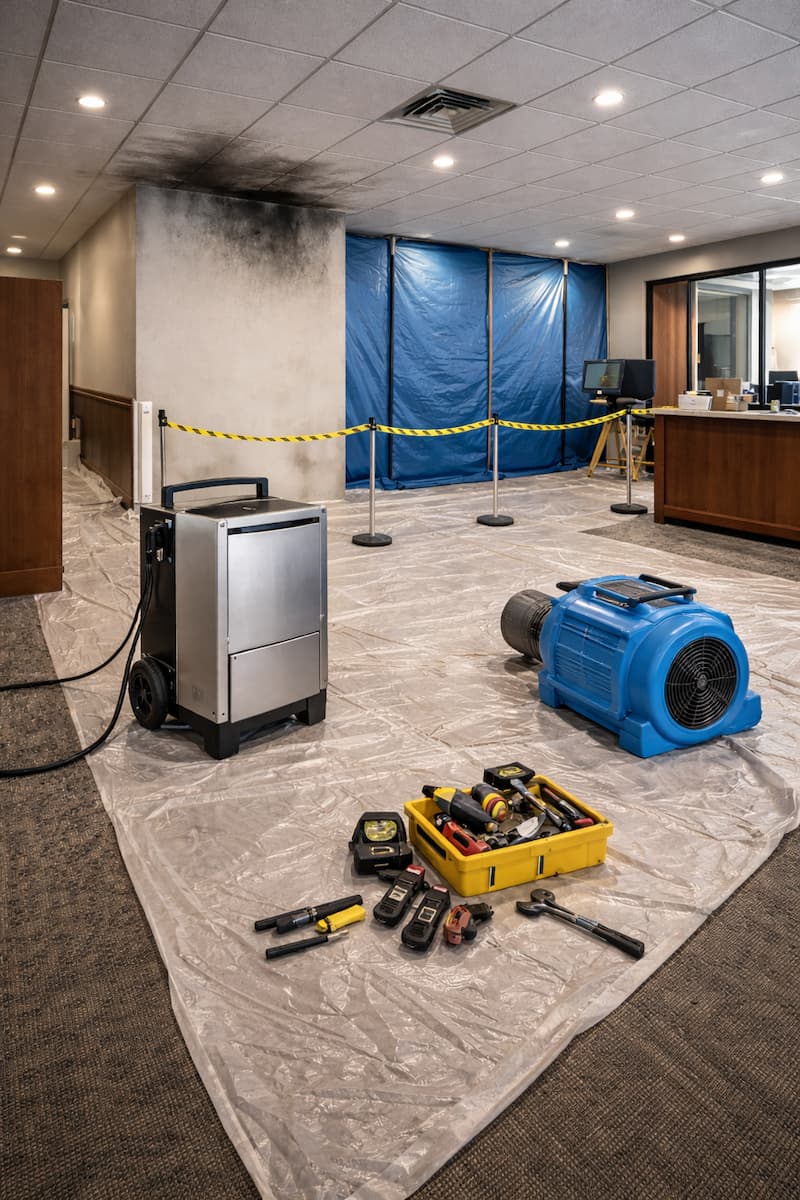
Commercial fire restoration planning changes with the type of property and how it is used.
Offices, retail suites, restaurants, mixed-use buildings, apartment common areas, and smaller commercial interiors all carry different operational pressures. The restoration plan should reflect the occupancy, the traffic pattern, the building rules, and the level of disruption the space can tolerate.
Offices and professional suites
Workstations, records, electronics, conference rooms, and shared corridors can all shape the sequence of work. Smoke migration and access to still-needed business areas often matter just as much as the visibly damaged room.
Retail spaces and showrooms
Front-of-house appearance, customer circulation, damaged stock, signage, and partial reopening decisions can change the restoration priorities. A retail property may need a plan that separates public-facing areas from storage or repair zones.
Restaurants and food-service properties
Kitchen equipment, grease-related residue, ventilation pathways, refrigeration, and code-sensitive work areas can make fire restoration more involved. Coordination matters because cleanup, drying, repairs, and reopening decisions are tightly linked.
Mixed-use buildings, common areas, and smaller commercial interiors
Shared entries, stairwells, apartment common areas, managed corridors, and compact tenant spaces can create tight access conditions. These projects often require closer coordination with management and clearer separation between affected and unaffected occupants.
A balanced process that moves from emergency conditions toward reoccupancy and return to service.
Every loss is different, but commercial projects often move best when the workflow stays organized and the next phase is defined before the current one ends.
Initial commercial loss review
Review the fire-affected areas, access limits, occupancy issues, and how smoke, soot, or suppression water may be influencing the wider property.
Stabilization and scope planning
Set containment, protect less-affected zones, identify priorities, and organize the first restoration phase around safety, logistics, and operational realities.
Coordinated cleanup, drying, and smoke/soot response
Move the commercial project forward with connected work sequencing rather than isolated tasks, so cleanup and moisture control support the larger recovery plan.
Repair and restoration progression
Advance into repair scopes, finish recovery, and trade coordination with a clearer view of what can be restored first, what still needs protection, and what remains offline.
Readiness for reoccupancy or return to service
Close the loop with practical readiness planning for reopened suites, customer-facing areas, staff return, or phased occupancy, depending on how the building and the business need to recover.
Commercial fire restoration in Boston often means tighter access, shared building rules, and denser property layouts.
Boston commercial buildings can create practical challenges that affect how a fire-loss project is staged. Urban loading conditions, limited parking, narrow service routes, older construction, and mixed-use occupancy all change how teams enter, contain, move materials, and sequence restoration work.
In business districts and managed buildings, the job may also need to fit around security procedures, elevator reservations, tenant notices, shared entries, and building engineer coordination. Those are not side issues. They are part of how the commercial restoration plan succeeds.
Questions businesses and property managers often ask after a commercial fire loss.
What makes commercial fire damage restoration different from residential restoration?
Commercial projects usually involve more coordination around occupancy, access, building rules, stakeholders, equipment, shared systems, and reopening goals. The restoration plan often needs to address operations and logistics as much as the visible fire damage itself.
Can you help reduce downtime for a business after a fire?
Where conditions allow, the work can sometimes be phased so the most important business areas are stabilized or restored in a practical order. That does not eliminate downtime in every case, but it can help reduce avoidable delay and improve decision-making.
Do you work in offices, retail spaces, restaurants, or mixed-use buildings?
Yes. Commercial fire losses can involve office suites, customer-facing retail areas, restaurant interiors, managed mixed-use properties, apartment common areas, and smaller commercial tenant spaces, each with different restoration priorities.
Can restoration be phased around parts of the property that are still usable?
In some cases, yes. If unaffected or less-affected areas can be protected and safely separated from the active loss zone, a phased plan may be possible. The right approach depends on the building, the extent of smoke and soot spread, access conditions, and occupancy requirements.
Do you coordinate cleanup, drying, and repairs as part of one commercial workflow?
That is typically the goal. Commercial fire losses are easier to manage when cleanup, suppression-water follow-up, smoke/soot response, documentation, and repair planning are sequenced as connected parts of the same project.
How do you handle access and building-management coordination?
Commercial properties often require coordination around shared entries, service elevators, tenant notifications, security procedures, building engineers, or approved work windows. Those access realities are usually built into the restoration plan from the beginning.
Do you document the scope for insurance and decision-making?
Yes. Clear notes on affected areas, current conditions, work phases, and the practical scope of the loss help owners, managers, and adjusters review the commercial project with better visibility.
What happens after the emergency phase is over?
Once the site is stabilized, the project typically moves into the next defined phase: coordinated cleanup, drying where needed, smoke and soot response, repair planning, and a practical path toward reoccupancy or return to service.
Request a Commercial Fire Damage Restoration Quote
Tell us about the fire loss, the type of business property, and what is affecting operations right now. We’ll respond with practical next steps for stabilization, commercial cleanup coordination, scope clarity, and the path toward usable space.
Get a Fast Estimate
Usually replies within 15 minutes. No spam.

Evan Calloway
- IICRC FSRT — Fire and Smoke Restoration Technician
- IICRC OCT — Odor Control Technician
- IICRC WRT — Water Damage Restoration Technician
- IICRC CPT — Contents Processing Technician
- Xactimate Estimating Training — Level 2
- Restoration Industry Association (RIA) — Membership
- Claims Documentation & Contents Inventory Workflow Training
- Works with an IICRC Certified Firm (Boston Restoration Prime)