

Restoration in Sudbury, Massachusetts
Restoration Company in Sudbury, MA
The mark on the ceiling or wet edge of the floor may be only the part you can see. Boston Restoration Prime helps Sudbury property owners investigate the affected area and organize restoration around the findings. We offer 24/7 emergency help for water, fire, mold, storm and sewage damage in homes and businesses.
Get Immediate Help Now
Request your free, no-obligation estimate.
Read the room, then check the rooms around it
Start with when the stain appeared. Did it follow rain, an upstairs shower or an appliance cycle? Water can travel along framing before it reaches the ceiling, so we inspect accessible areas around the visible mark as well as the mark itself.
We take moisture readings to help define the affected boundary. A thermal pattern can guide investigation when that method is appropriate, but suspected moisture still needs verification. We discuss openings needed to check a concealed cavity or reach wet insulation.
Stay away from a sagging ceiling or water near electrical equipment. Do not puncture a ceiling to release water. Leave the area and call emergency services if the condition presents an immediate threat.
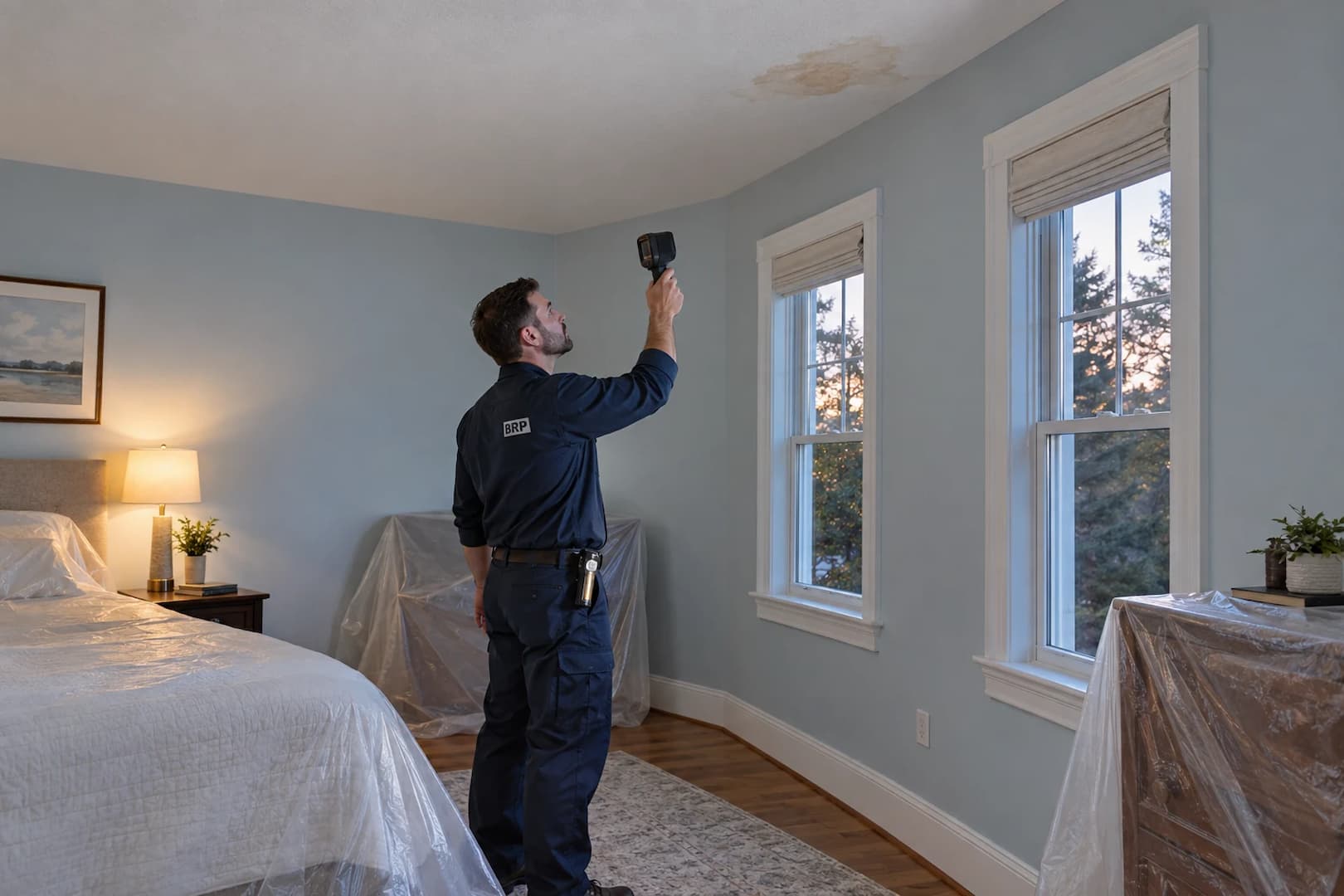
Sudbury context belongs in the assessment, not in assumptions
Sudbury has wetland and floodplain areas documented by the town. Your indoor damage still needs its own explanation. A pipe leak and water entering near a foundation can occur in the same neighborhood and require different source repairs.
Tell us whether the problem repeats after particular weather, whether a previous repair was attempted and which rooms have changed. A date-stamped photograph from an earlier occurrence can help explain the history. We use the observations without assuming that every local property faces the same exposure.
If the source remains active, arrange the appropriate plumber, roofer or other trade while we discuss damage mitigation. Restoration addresses what became wet or contaminated; it does not replace repair of the cause.
Work outward from the source
Establish the affected area
Inspect accessible materials around and below the apparent source. Record the findings and identify any further access needed before the scope can be settled.
Remove water and make material decisions
Extract water where appropriate, assess contamination and decide which damaged layers need removal. Protect clean areas while equipment and materials move.
Dry and clean what can remain
Position drying equipment for the actual assembly and monitor the response. Cleaning requirements depend on exposure and material condition.
Prepare the area for repair
Discuss completion conditions, unresolved source issues and the materials needed for rebuilding. Do not close wet layers behind a new finish.
Our water damage restoration scope follows these decisions, but the details vary. A clean supply leak, outdoor water and sewage are not interchangeable situations. The assessment determines the method and the safe working boundary.
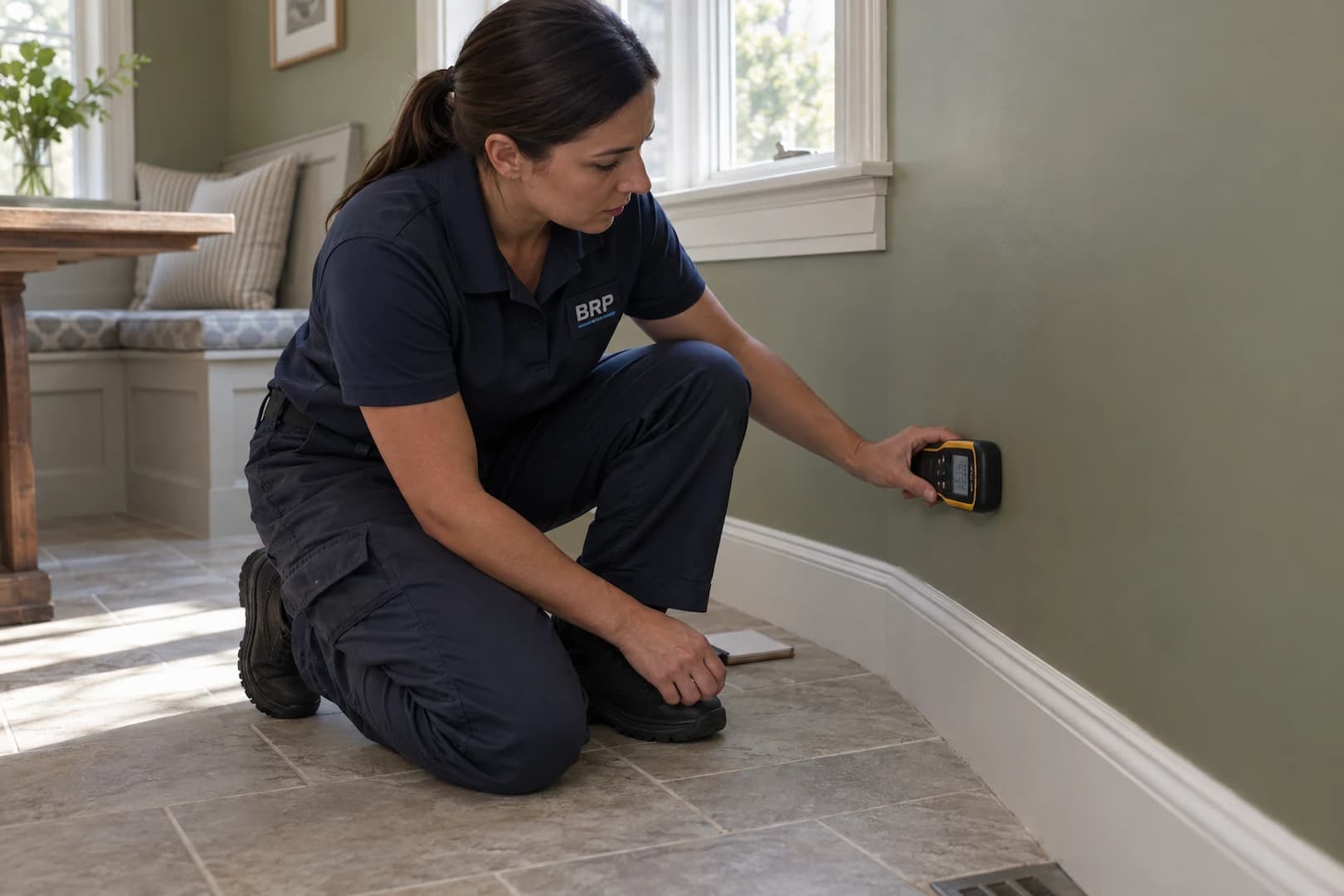
Where a careful material decision pays off
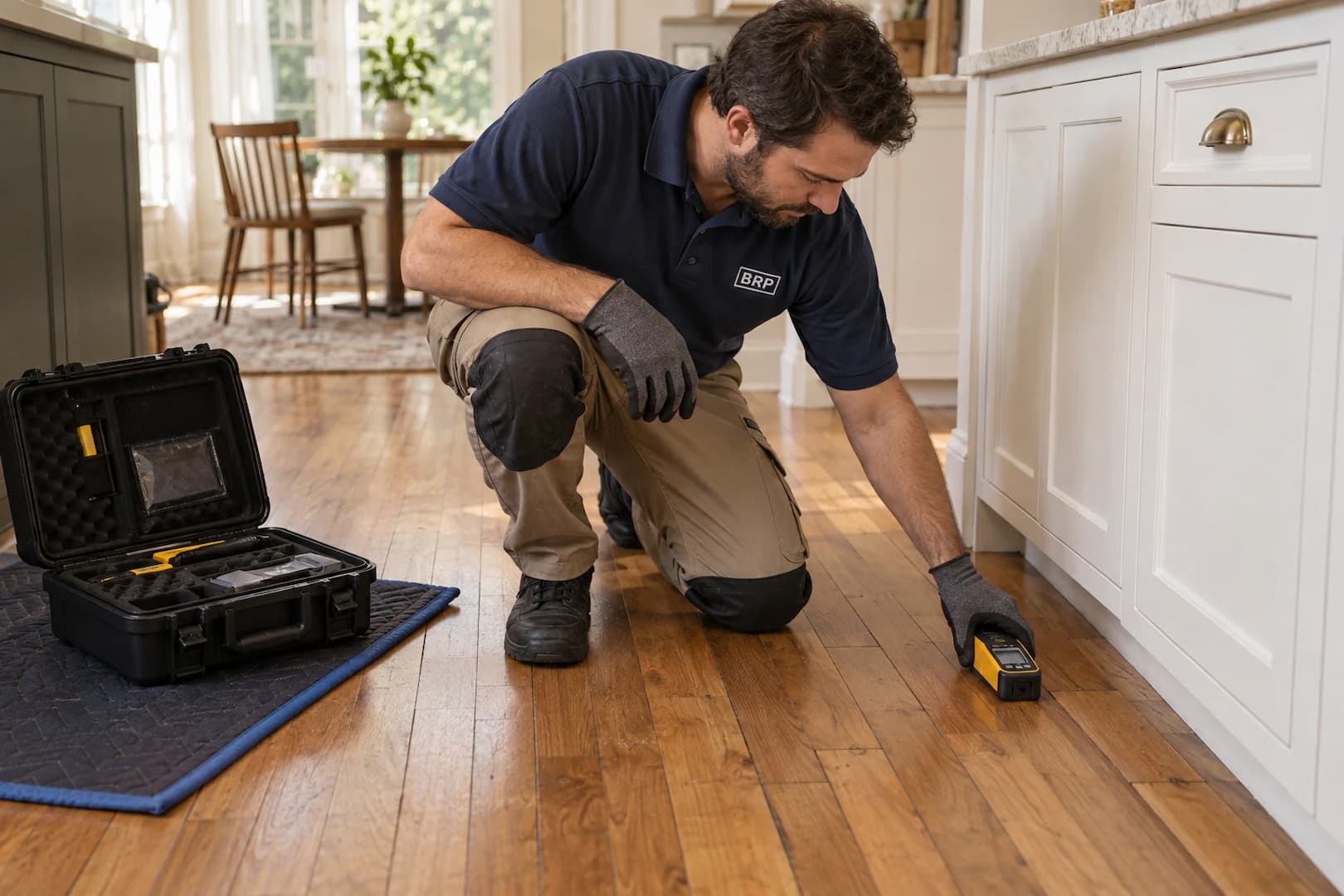
Cupped boards draw attention, but the subfloor also needs checking. We assess the wood and the layers beneath it before discussing whether drying is reasonable. Replacing a finish over a damp substrate would leave the main problem in place.
Cabinet bases can hide wet voids, and composite panels may swell beyond useful recovery. Drywall and insulation need decisions based on exposure, deterioration and contamination. We explain the reason for selective removal rather than applying one rule to everything in the room.
Belongings need a separate inventory and handling plan. Tell us which items need early assessment and where unaffected essentials can be kept. Contents restoration addresses cleaning and movement; it does not guarantee that every damaged item can be saved.
Some losses need a different kind of separation
Smoke residue after fire
After responders release the property, we assess residue on surfaces and belongings along with extinguishing water. Avoid wiping soot or spreading it through unaffected rooms. Fire and smoke restoration may require cleaning tests and attention to odor sources beyond the burned area.
Mold around recurrent dampness
We investigate the moisture history and affected material before defining mold remediation. Containment and careful removal may be needed. A repaired leak is part of the plan, but the material already affected still needs its own assessment.
Sewage in a lower room
Keep the area closed to normal use and avoid fans that may spread contamination. Sewage cleanup addresses affected materials and surfaces. A plumbing or system contractor must investigate the reason for the backup.
Stormwater through an opening
Wind or rain may create both exterior and interior work. We discuss the restoration scope while the suitable trade addresses the opening. Record when water enters and whether it continues after the weather changes.
The work boundary also affects people. Tell us about children, pets and anyone who needs a clear route through the house. We discuss whether occupied use is practical; a closed door alone does not settle that question.
What progress should look like
Ask what the latest readings show and what happens next. Equipment may need adjustment when a material stops responding as expected. Contact us if a unit stops or another contractor needs to change the setup.
Time depends on the wet layers, access, contamination and source correction. The first visit provides a basis for discussing the next checkpoint; it cannot guarantee a date for every finish repair. A concealed wet area found during removal may change that plan.
Costs follow the scope: extraction, cleaning, removal, equipment use, contents work and repairs. Ask which items are included and what would require an updated estimate. A useful explanation ties the change to a material or condition found in the property.

We document damage and work performed to support your records and insurance discussions. Keep your discovery timeline and source-repair receipts. Your insurer decides coverage and payment, including how the cause of loss is treated under the policy.
Questions about Sudbury damage restoration
Is a small ceiling stain worth checking?
Yes, especially if it changes or returns. The visible mark may not show the extent of wet insulation or framing. We discuss inspection of the accessible affected area.
Can you take an emergency call overnight?
Yes. Emergency help is available 24/7. Share the Sudbury address, type of damage and whether the source is still active so we can discuss the response.
Will painting remove a musty smell?
Paint does not correct a moisture source or remove affected material behind the surface. A recurring odor needs assessment before the area is refinished.
Must all wet drywall be removed?
The decision depends on condition, contamination and access to the wet assembly. We explain the findings and proposed removal boundary rather than assuming a full-room replacement.
Can I use the room while it dries?
Sometimes, if the work area and access permit it. Equipment, contamination or essential-room restrictions may make that impractical. We discuss the conditions found at your property.
Do you restore commercial spaces too?
Yes. Tell us the suite, access contact and operating constraints. Shared systems, neighboring spaces and customer routes may need to be considered in the scope.
Boston Restoration Prime · Sudbury
Start with what you noticed at your Sudbury property
Call 617-639-0909 with the address, affected rooms and the time the problem appeared. Mention any earlier leak or repair in the same area. We will discuss assessment, emergency mitigation and access for the next step.
in SudburyCall 24/7 ↗